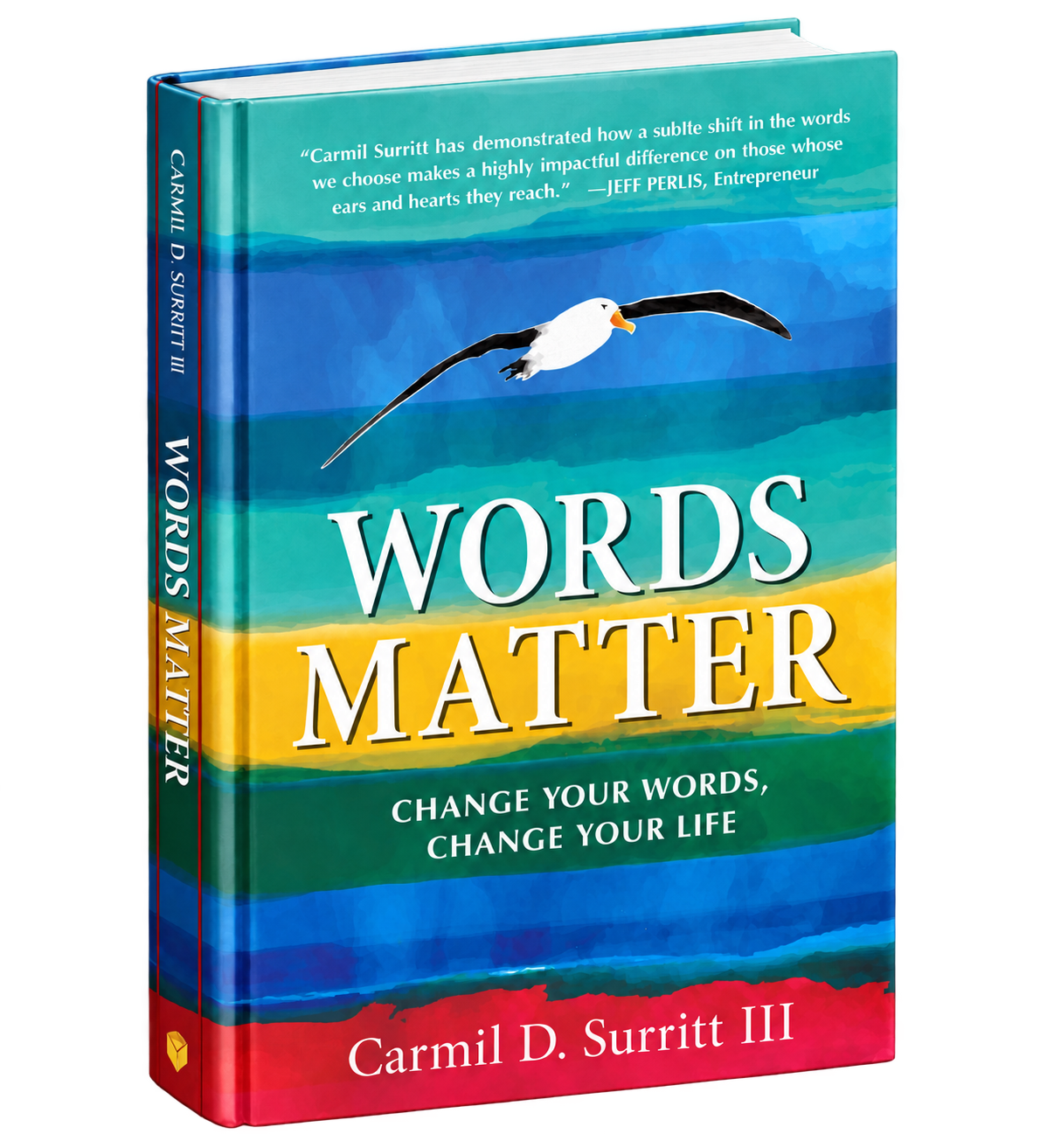
Words Matter
Change Your Words, Change Your Life
By Carmil D. Surritt III
The words you choose can change a conversation.
Change enough conversations, and you can change a relationship.
Change your relationship with words, and you may change your life.
Words can inspire, acknowledge, reassure, and open the door to understanding.
They can also judge, criticize, confuse, shame, diminish, and divide.
Most of the time, we are not even conscious of the impact they are having.
Words Matter: Change Your Words, Change Your Life explores how the language we use with others, and with ourselves, influences trust, safety, belonging, self-worth, relationships, and the way we respond to one another.
Sometimes much more than we realize.
We communicate all day long.
With our partners.
With our children.
With coworkers and employees.
With friends.
With the people we lead.
And constantly, internally, with ourselves.
Some words create clarity, acknowledgment, confidence, connection, and trust. Others can create doubt, fear, defensiveness, shame, confusion, and separation.
In Words Matter, Carmil Surritt invites readers to become more conscious of that difference and begin noticing how seemingly ordinary language can affect the people on both sides of a conversation.
The objective is not perfect communication. It is greater awareness and greater choice. Because once we become aware of the impact our words are having, we can begin choosing them more intentionally.
Communication affects one of our most fundamental human needs: connection.
We all want to feel safe.
We want to be seen and heard.
We want to know that we matter.
We want to belong.
Carmil explores how the language we hear and use can either contribute to fear and separation or help create safe, trusting connections.
When we feel threatened, criticized, shamed, or judged, our instinct can be to defend ourselves, withdraw, fight back, or shut down.
When we feel safe enough to stay engaged, something different becomes possible:
Words Matter is about becoming more conscious of which environment our language is helping create.
Words you may use every day without thinking about them.
Three of the central words Carmil examines in the book are:
“What you should have done…”
“You shouldn’t have said that…”
Carmil explores how should can easily shift a conversation from learning and problem-solving into judgment, shame, or blame.
Ask a question.
Instead of telling someone what they should have done, invite them to think:
“What may have been another way to accomplish this?”
“If you could approach it differently next time, what might you do?”
Questions can create an opportunity for curiosity where judgment might otherwise create defensiveness.
“Don’t do that.”
“That’s not right.”
“That’s not how I would have done it.”
We are often extremely clear about what we do not want. The problem is that the other person may now have to figure out what you do want.
Communicate the desired outcome more clearly.
Instead of:
“I don’t want you to leave those dishes in your room.”
Try: “When you are finished, please put your dish in the dishwasher.”
One creates something to avoid. The other creates clarity about what to do.
“You did a great job, but…”
“I really like your idea, but…”
“I hear what you’re saying, but…”
The moment we hear but, we often begin waiting for everything that came before it to be canceled.
BUT → AND
Carmil explores the difference a simple substitution can make:
“You did a great job, and I wonder what we could do to make it even better.”
The feedback did not disappear. The conversation simply changed.
Words Matter asks a powerful question:
What becomes possible when we communicate in ways that invite engagement instead of defensiveness?
What if we approached conversations from connection instead of separation?
One of the themes running through Words Matter is our tendency to focus on difference.
Different beliefs.
Different choices.
Different backgrounds.
Different conclusions.
Different ways of seeing the world.
Carmil challenges readers to shift the focus.
What happens when we begin a conversation by remembering what we share?
Similar needs.
The desire to feel safe.
The desire to matter.
The desire to be understood.
The desire to belong.
Changing that perspective can change the way we approach the person standing in front of us. And changing the way we approach the conversation can change what happens next.
Broken trust does not always have to be the end of the relationship.
Many of us think about trust as an all-or-nothing proposition: I trust you. Or I don’t.
Carmil challenges that idea.
The book explores trust as something that can be created, strengthened, damaged, repaired, and rebuilt.
Carmil focuses on four areas that help create stronger trusting relationships:
He then takes readers through an Accountability Process designed to address broken agreements through inquiry rather than shame and blame.
What if accountability created learning instead of defensiveness?
Accountability does not have to mean attacking someone for what they did wrong. In Words Matter, Carmil presents a practical process for examining broken agreements while staying curious about:
- What was agreed to?
- What happened?
- What choice was made?
- What became more important in that moment?
- How did that choice affect other people?
- What could happen differently next time?
The goal is not to win the argument. The goal is awareness, responsibility, learning, and the possibility of rebuilding trust.
Carmil describes this accountability process as one of the most useful tools he has learned and adapted through decades of working with people.
Hearing words and truly listening are not the same thing.
We spend a great deal of time thinking about what we are going to say.
But communication also depends on our ability to understand what another person is trying to communicate.
Carmil explores different levels of listening, from being completely distracted to being fully present, curious, and committed to understanding both the words and the message behind them.
The goal is not merely:
“I heard you.”
It is:
“I am present, and I want to understand.”
Effective listening can change the quality of communication between parents and children, partners, leaders and employees, friends, and virtually anyone trying to create a stronger relationship.
You are part of every conversation you have with yourself.
Some of the most damaging words we hear may eventually become words we repeat internally.
“I’m not good enough.”
“I always mess this up.”
“I’ll never get this right.”
“I should be better than this.”
Words Matter examines how our language can influence self-worth and self-belief and encourages readers to question conclusions they have accepted about themselves.
The same principles that can create more compassionate, productive conversations with others can also change the conversation happening inside our own minds.
Because changing your words is not only about communicating differently with other people. It is also about changing the way you speak to yourself.
A journey from reaction to awareness.
Throughout the book, Carmil explores topics including:
These themes make up the 21-chapter journey Carmil takes readers through in Words Matter.
Change your words. Change your life.
Begin the 21-chapter journey from reaction to awareness with Carmil D. Surritt III.
Get the Book